
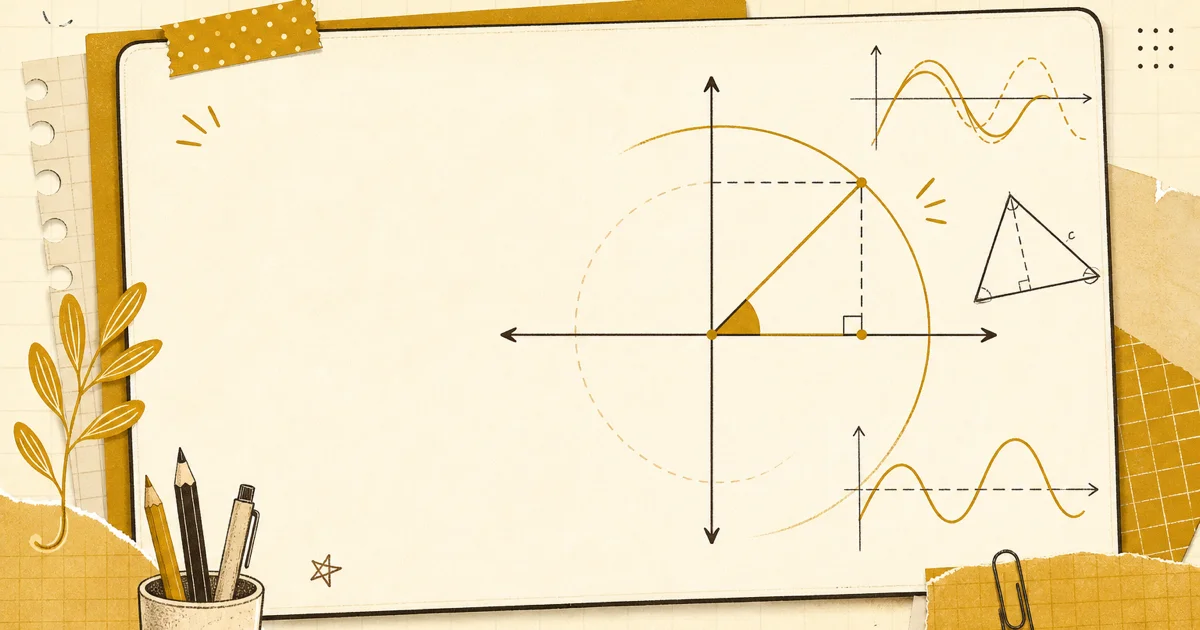
Cofunctions in Trigonometry
Understand cofunctions through trigonometry frameworks: right triangles, unit circle positions, and identity-based simplification.
By Cofunction Calculator Team May 25, 2026
Quick Answer
- Short definition
- In trigonometry, cofunctions describe equivalent function values across complementary angle positions.
- Formula
- sin(θ) = cos(90° - θ)
Introduction
Cofunction Calculator supports classroom and self-study trigonometry practice by turning identity rules into immediate numeric checks.
Cofunctions appear in multiple trigonometry views at once: triangle ratios, unit circle coordinates, and graph relationships. This article connects those views so the identities feel intuitive instead of memorized.
Main Content
What is it?
In trigonometry, cofunctions explain why different function names can represent the same value at complementary angles. Sine and cosine swap opposite/adjacent roles relative to complementary acute angles in a right triangle.
On the unit circle, this appears as a coordinate-role swap under complementary reference angles. For a visual deep dive, continue with Cofunction Identities on the Unit Circle.
Formula
Core trigonometry cofunction formulas:
- sin(θ) = cos(90° - θ)
- tan(θ) = cot(90° - θ)
- sec(θ) = csc(90° - θ)
Keep the full list nearby via Cofunction Identities while solving mixed-problem sets.
Step-by-step guide
- Draw or label the angle in a triangle or unit circle context.
- Find the complementary angle.
- Map the function to its cofunction partner.
- Rewrite the expression using trigonometric identity rules.
- Verify with known values or calculator output.
Example
In a right triangle with acute angles 34° and 56°, sin(34°) equals cos(56°). The two acute angles are complementary, so their trigonometric roles swap accordingly.
This same relationship appears in unit circle reasoning and in graph-based identity explanations.
FAQ
Yes. Cofunctions are foundational for simplifying expressions before double-angle and half-angle rules.
They appear in identity simplification, triangle trigonometry, and unit circle questions.
Conclusion
Cofunctions connect geometry and function algebra in trigonometry. When you can move between triangle, circle, and identity views, your problem-solving speed improves significantly.
Validate each trigonometry example with the calculator as you study.