
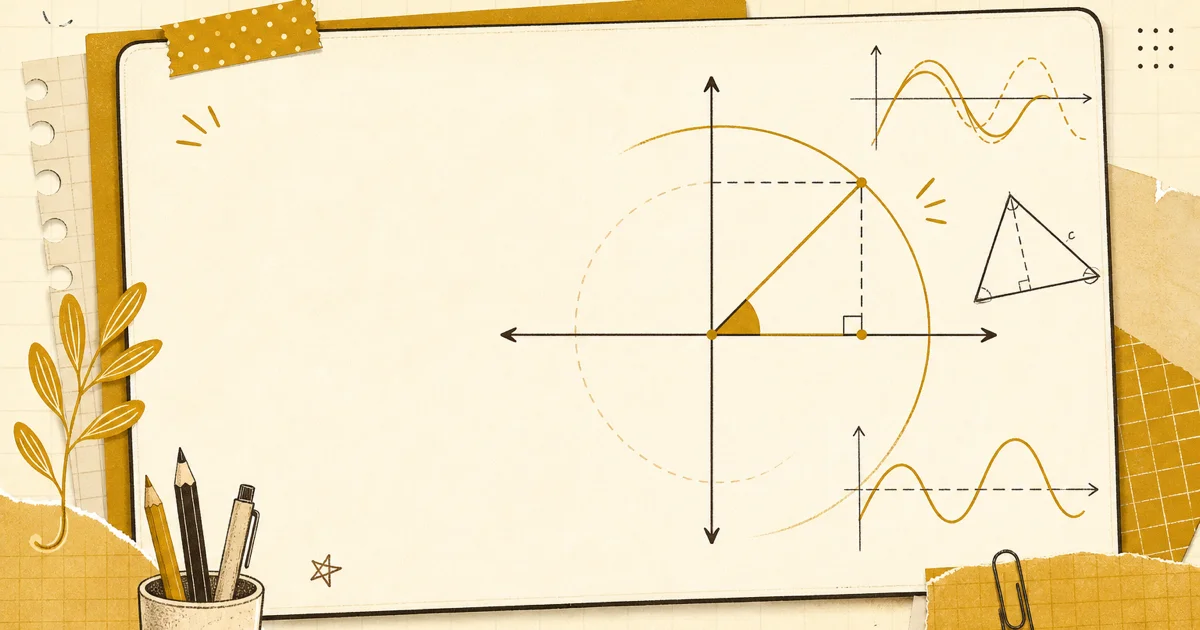
Cofunction Identities on the Unit Circle
See how cofunction identities appear on the unit circle through complementary angle positions and coordinate role swaps.
By Cofunction Calculator Team May 27, 2026
Quick Answer
- Short definition
- On the unit circle, cofunction identities reflect equivalent values at complementary reference angles through x and y coordinate role swaps.
- Formula
- sin(θ) = cos(90° - θ)
Introduction
Cofunction Calculator helps connect unit circle reasoning with numeric identity checks, which makes abstract angle relationships easier to trust.
Unit circle visualization is one of the strongest ways to understand why cofunction identities are true. This article explains the geometry behind the formulas and shows how to verify each relationship with examples.
Main Content
What is it?
On the unit circle, each angle corresponds to a coordinate pair (cos t, sin t). For complementary angles, the roles that define sine and cosine swap in a way that preserves value equivalence across cofunction identities.
If you want the broader trigonometry context first, read Cofunctions in Trigonometry and then return here for the circle-specific interpretation.
Formula
Key unit circle cofunction formulas:
- sin(θ) = cos(90° - θ)
- cos(θ) = sin(90° - θ)
- tan(θ) = cot(90° - θ)
Pair this visual framework with the complete identity list in Cofunction Identities for full coverage.
Step-by-step guide
- Plot θ on the unit circle and mark its reference position.
- Compute the complementary angle 90° - θ.
- Compare sine and cosine roles for both angles.
- Write the corresponding cofunction identity.
- Verify numerically using calculator checks.
Example
Let θ = 25°. Complementary angle = 65°.
Unit circle reasoning gives sin(25°) = cos(65°). You can verify this by comparing decimal outputs or using the homepage calculator.
Repeat with θ = 40° to confirm sin(40°) = cos(50°).
FAQ
The identity is general, but visual explanations are clearest for acute angle examples.
It gives a geometric reason for each formula, which improves long-term recall.
Conclusion
Unit circle thinking turns cofunction formulas from memorized statements into spatial relationships you can reconstruct during exams.
Check each unit circle example numerically to connect visual reasoning with exact values.